
In September 2025, a psychology explainer in The Conversation asked whether ASMR really helps with anxiety and answered: “To date, there are no clinical trials that link ASMR with short- or long-term therapeutic effects.” PsyPost republished it in January 2026.
There are trials. Studies published since 2022 have tested ASMR on adults waiting for surgery in Sydney, children having dental injections in India, stressed adults and people with mild depression in South Korea, and women in a compulsory drug-detox centre in China. Two lab studies in England have measured what it does to pain. The studies are small and scattered across journals in anaesthesia, dentistry, psychiatry, neuroscience and pain research, which may be why they are easy to miss. Read together, they say something more useful than a plain yes or no.
The pattern is this: when ASMR is compared with doing nothing, the results often look positive. When it is compared with another video or relaxation method, it mostly ties on anxiety, stress and mood. And in the studies that compared them, the larger changes tend to show up in people who actually feel the tingles.
So the explainer was out of date on whether trials exist, but its caution about the evidence holds up.
Can ASMR be used as therapy? The short answer
- ASMR has been tested for anxiety before surgery and dental treatment, for everyday stress, for mild depression, for drug craving and for pain.
- Most of the positive results come from comparisons with no treatment, which cannot separate ASMR from the expectation of feeling better.
- Where ASMR did beat an active comparison, the advantages were small for heart rate (about two beats per minute, in one lab study) and blood pressure (about 4 mmHg, in the surgery trial). In one online study, ASMR responders also scored higher on relaxation than walking-tour viewers, but that compared a responder subgroup with a separate, non-randomised sample.
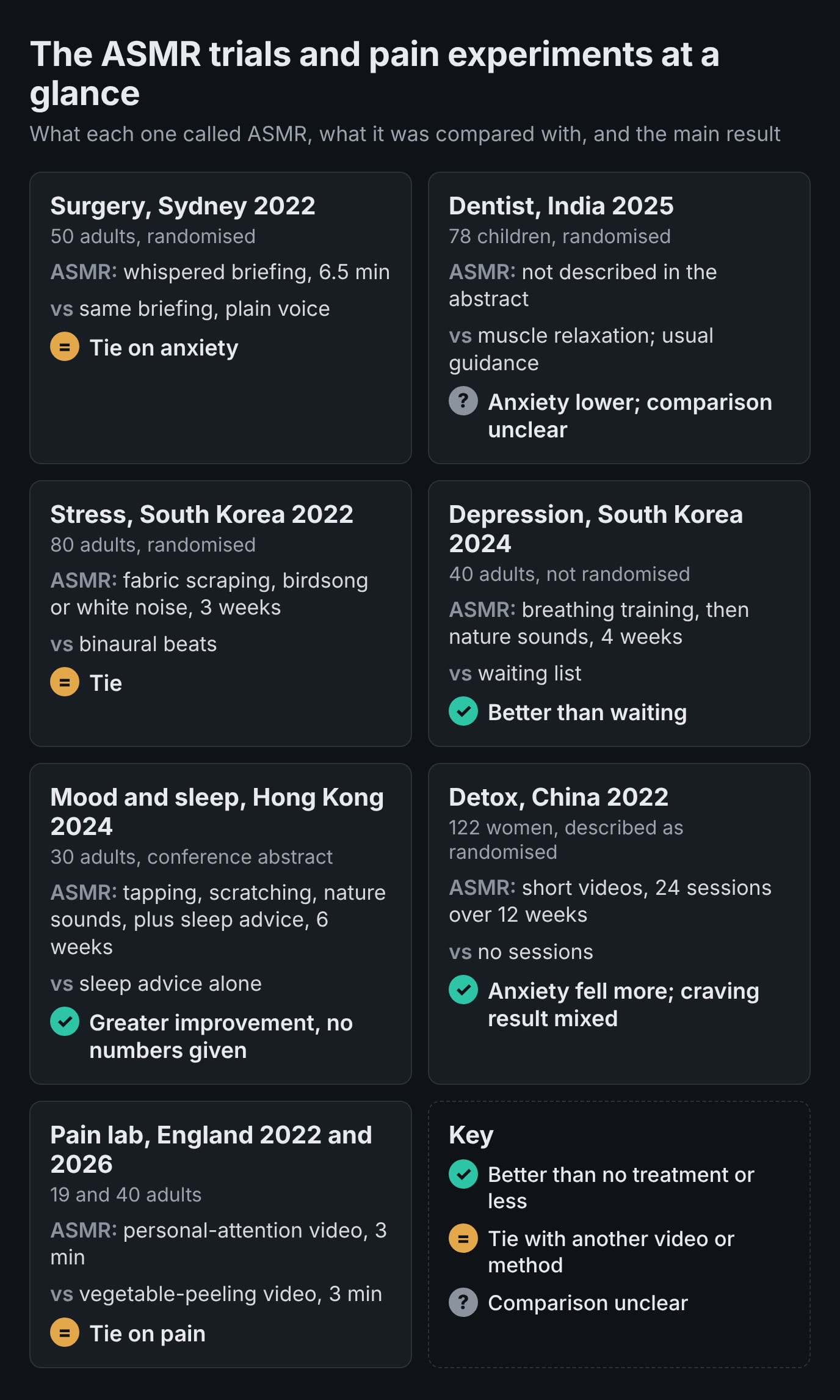
The intervention trials and pain experiments so far, with what each one called ASMR and what it was compared with:
Anxiety before surgery and at the dentist
The anaesthesia trial ran in the day-surgery unit at Sydney Adventist Hospital. Carlaw and colleagues randomised 50 adults booked for general anaesthesia to watch one of two videos less than two hours before their operation, in a double-blind, placebo-controlled trial published in 2022. Both videos gave the same information about what to expect around the operation. One delivered it with slow whispering, tapping, crinkling and personal attention. The other used an ordinary conversational tone. None of the patients had prior experience with ASMR, according to the paper.
After the videos, the two groups did not differ significantly on any of the three anxiety measures. Systolic blood pressure ended about 4 mmHg lower in the ASMR group than in the control group (a borderline result, p = 0.043), and the authors judged the ASMR group’s own 2.7 mmHg fall unlikely to be clinically significant. Their summary: “Our results are conflicting, and we cannot confirm an anxiolytic effect of ASMR.” The authors flag two weaknesses. The ASMR video ran about six and a half minutes against under three for the control, and nobody checked which patients could feel ASMR at all. “Further studies targeted specifically at ASMR responders may more accurately assess its effects on pre-operative anxiety,” they write.
The dental trial is harder to read. In a 2025 randomised trial in the European Archives of Paediatric Dentistry, Tanna and colleagues split 78 children aged 7 to 11, all needing a local anaesthetic injection, into three groups: progressive muscle relaxation (tensing and releasing muscle groups in turn), ASMR, or conventional behaviour guidance. The published abstract reports that both relaxation methods lowered blood pressure during local anaesthesia, and that ASMR “significantly reduced these scores during injection” on a facial anxiety scale. It does not say whether these are changes within each group or differences from the conventional-guidance group, and it gives no group averages, so the result cannot be set against a comparator. The full paper was not available for this post.
Bottom line: In the one surgery trial that compared ASMR with an equally informative plain video, ASMR did no better on anxiety. The dental trial’s abstract reports lower anxiety with ASMR, but not whether it beat the usual approach.
Does ASMR help with stress, depression or craving?
Stress
The stress trial ran at Seoul National University Bundang Hospital. Lee and colleagues, writing in Scientific Reports in 2022, randomised 80 adults with high stress, plus signs of depression, insomnia or anxiety, to three weeks of either ASMR or binaural beats (music with a slight pitch difference between the ears). Participants listened for about 15 minutes in the day and 30 minutes at bedtime.
Both groups improved substantially on stress, depression, insomnia, anxiety and quality of life, and the two groups did not differ. “Both ASMR and BB are equally effective in reducing stress levels,” the authors conclude. Two details matter. There was no group that received nothing, so the improvement cannot be separated from time passing or from expecting to feel better. And the “ASMR” was a choice of three sounds: scraping non-woven fabric, birdsong, or white noise.
Depression and mood
A 2024 study in Psychiatry Investigation by Kim and Park tested ASMR on 40 adults with mild depression diagnosed by a psychiatrist, at a mental health centre in South Korea. The programme ran eight 50-minute sessions over four weeks: breathing and relaxation training first, then “ASMR” built from nature sounds such as crackling firewood, running water, crickets and rain. At the end, depression scores were significantly lower than in a waiting-list group. But the study was not randomised and had no breathing-only group, which the authors acknowledge makes it “challenging to distinctly attribute the clinical effects observed solely to one training technique.”
Two more studies point the same way with weaker designs. A randomised study presented as a conference abstract at Hong Kong’s Hospital Authority Convention in 2024 (Chan and colleagues, not a peer-reviewed paper) gave 30 people with mood and anxiety problems either ASMR recordings at night, at least four nights a week, plus sleep-hygiene education, or the education alone, for six weeks. Both groups improved on anxiety and depression, and the abstract reports “significantly greater improvements” in the ASMR group, though it gives no numbers.
An online study by Smejka and Wiggs in the Journal of Affective Disorders (2022) found that after a single ASMR video, mood improved most in adults who had depressive symptoms on a questionnaire and reported experiencing ASMR. The authors call that analysis exploratory, the groups of people who did not experience ASMR were very small, and there was no comparison video. Part of the sample was recruited through the video’s own YouTube description and the creator’s Facebook page.
Craving
One trial ran in a compulsory drug-detoxification centre for women in Zhejiang, China. Hu and colleagues (Brain and Behavior, 2022) gave 60 women, almost all of them methamphetamine users, 24 sessions of short ASMR videos over 12 weeks, and compared them with 62 who had none. The ASMR group’s attention to drug-related cues on a reaction-time task fell while the control group’s did not, though the study’s main combined analysis found no significant effect. Anxiety fell more in the ASMR group, but the paper is inconsistent about when, and the authors themselves caution that “the significant effect may be exaggerated.”
Bottom line: Every study in this section found that people improved. None could separate ASMR from expectation or from the rest of the programme, and the only one that compared it with another relaxation method found a tie.
Does ASMR help with pain?
This is where the evidence gets counter-intuitive. A research group at Bath Spa University ran two experiments, published in Perception (2022, 19 participants) and PAIN Reports (2026, 40 participants), pressing a device against the forearm. In 2022 they recorded the point at which the pressure became intolerable; in 2026, the point at which it first became painful. Each person was tested three ways: with no video, during a three-minute ASMR video built on personal attention (a hairdresser role-play in the 2026 study), and during a three-minute control video of someone peeling vegetables. Both videos came from YouTube.
Both times, people who experience ASMR rated the pain as worse than people who don’t. The 2022 paper puts it directly: “This exploratory study has found that ASMR is associated with increased pain sensitivity.”
Pain tolerance in 2022, and pain thresholds in 2026, did rise during the ASMR video. They rose about as much during the control video: in both studies, the differences between the two videos were tiny (adjusted p = 1.00). In the 2026 study, men’s thresholds rose during both videos while women’s did not change. The 2026 abstract still describes “ASMR’s potential as an analgesic mechanism”, but a video of someone peeling vegetables did about as well.
Bottom line: In the lab, an ASMR video raised pain tolerance and pain thresholds about as much as an ordinary comparison video did. The people who feel ASMR also seem to feel pain more.
Why results differ from person to person
Most of the trials did not screen for who feels ASMR. Lab studies that separate the two show why that may matter.
- Anxiety fell only in people who feel it. In PLOS ONE (2022), Eid, Hamilton and Greer showed one five-minute video to 64 adults recruited through ASMR forums, YouTube channels and social media, in an online before-and-after study with no comparison video. State anxiety (how anxious someone feels right now) fell in those who experience ASMR and did not change in those who don’t: “watching ASMR alleviated state anxiety but only in those who experienced ASMR.” There is a catch. The experiencers started out more anxious and ended at about the same level as the non-experiencers, so some of the drop may be a return to typical levels.
- A walking-tour video scored higher on positive mood overall. Lohaus and colleagues (PLOS ONE, 2023) compared separate online samples, mostly German students, who watched ASMR videos (205 people) or walking-tour videos (96). Overall, the walking-tour group reported more positive affect. But ASMR responders scored higher than the walking-tour group on relaxation and positive affect, while non-responders scored lower than it on relaxation.
- Only liked videos lit up emotion areas. In a 2023 brain-imaging study in Frontiers in Human Neuroscience, Sakurai and colleagues scanned 30 young ASMR fans and found that emotion-related areas, including the amygdala and insula, were “activated only by liked ASMR videos.” The study did not measure anxiety, and relaxation was inferred from brain activity rather than measured.
- Heart rate fell a little across the whole group. The exception comes from Engelbregt and colleagues (Experimental Brain Research, 2022). Of 38 Dutch psychology students, 15 felt tingles. Across the whole group, heart rate was lower during a towel-folding ASMR video than during a video with a male voice explaining how to make pasta, by about two beats per minute (68.8 against 70.7), with no significant difference between those who felt tingles and those who did not.
Bottom line: If you feel ASMR, the lab studies suggest you are more likely to notice a change. If you don’t, a pleasant non-ASMR video may do as much, apart from a small dip in heart rate.
”ASMR” means different things in different trials
Look at the “ASMR:” line on each card in the figure above. The Korean stress trial offered birdsong and white noise, the depression study used firewood, water and rain, the Sydney trial a whispered briefing, and the pain studies a personal-attention video. All of it appears under one label.
The researchers know this. A 2024 Delphi study (a structured survey run in rounds) in Multisensory Research, led by Hostler and Poerio, asked researchers, ASMR creators and viewers to set the field’s research priorities: 98 people from 22 countries took part in the first round, and 69 voted in the second. Defining and measuring ASMR ranked first. “Therapeutic applications” ranked seventh of 13, with the note: “Rigorous studies (e.g., randomised controlled trials) and design-oriented projects would likely be a necessary first step.”
Bottom line: A “positive ASMR trial” may be a trial of nature sounds. Before trusting a headline, check what participants actually listened to.
Is ASMR safe?
None of these trials reported serious harm, though several did not report side effects systematically. The only adverse events reported were mild headaches: two people in the ASMR group of the Korean stress trial and one in the binaural-beats group. Separately, the Sydney authors mention that several patients’ anxiety scores rose after the ASMR video, though they say the numbers were too small to be statistically meaningful and one control patient reported the same. In interviews with eight women studying psychology at one UK university, all regular ASMR users, published in 2023 by Woods and Turner-Cobb, one described relying on it: “I genuinely could not sleep without it.” And the 2024 Delphi study lists the effects of long-term use, including dependency, as an open research question.
Bottom line: No serious harm turned up in these trials, but they were short, so they cannot rule out longer-term problems.
What the research still doesn’t settle
- Size and replication. The clinical trials here range from 30 to 122 participants, and no independent repeat of any of them turned up for this post. The pain finding has been repeated, but by the same team.
- Who responds. As far as their papers and abstracts show, only one clinical trial (Hu) compared people who are and are not sensitive to ASMR. It found no overall difference in anxiety between them, though the timing differed. The others did not screen, which may hide a real effect in responders or overstate it in everyone.
- What counts as ASMR. Until the field agrees on a definition, trials will keep testing different sounds under the same name.
- Long-term effects. The studies here ran from a single video to 12 weeks, and none of the papers or abstracts describes following people up afterwards.
The fairest summary of the mental-health evidence comes from the authors of the 2024 Delphi study: though growing, it “is not yet sufficient to guide medical professionals.”
If you want to try it
None of this is a tested protocol. These are suggestions drawn from the pattern above.
- Check whether you respond before expecting much. If you are not sure, the science behind ASMR and the trigger guide explain what to listen for.
- Use what you like. One brain-imaging study found that emotion areas responded only to videos people liked, so there is little reason to sit through triggers you find irritating.
- Treat one short clip as a test, not a cure. The Sydney trial’s video of under seven minutes, shown less than two hours before surgery, did no better than a plain one. The studies that found gains against nothing, or against less, ran for weeks but had weak designs, and single videos lowered anxiety or lifted mood in people who feel ASMR only in before-and-after studies with no comparison video.
- Treat it as an extra, not a treatment. The dental authors say both relaxation methods “can be used as adjuncts to basic behaviour guidance techniques”, and the depression programme combined ASMR with breathing training. Nothing here suggests ASMR can replace treatment.
Because the trials blur ASMR triggers with nature sounds, it is worth finding out which kind works for you. Some dedicated apps (including Tingles ASMR: Relax & Sleep) let you build a mix from trigger sounds alone or from nature sounds alone, so you can test one without the other.
What would settle it
A more telling trial would recruit people who actually feel ASMR, as the Sydney authors suggested, and compare an ASMR video with an equally pleasant video that is not ASMR.
So far, ASMR has mostly done about as well as the other videos and relaxation methods it has been tested against. Its clearest gains showed up among the people who feel it.
References
Clinical and intervention studies
- Carlaw, K. R., Ng, D. T. F., Kim, D., & Phillips, S. (2022). Does Triggering an Autonomous Sensory Meridian Response Reduce Pre-Operative Anxiety? A Randomized Placebo Controlled Trial. Anesthesia and Clinical Research, 2022(1), 1–7. DOI: 10.31487/j.acr.2022.01.02
- Tanna, D. A., Bhandary, S., Pentapati, K., & Hegde, S. (2025). Evaluation of progressive muscle relaxation and autonomous sensory meridian response in alleviating dental anxiety in children aged 7–11 years: a randomized controlled trial. European Archives of Paediatric Dentistry, 26(4), 719–729. DOI: 10.1007/s40368-025-01018-5
- Lee, M., Lee, H. J., Ahn, J., Hong, J. K., & Yoon, I.-Y. (2022). Comparison of autonomous sensory meridian response and binaural auditory beats effects on stress reduction: a pilot study. Scientific Reports, 12, 19521. DOI: 10.1038/s41598-022-24120-w
- Kim, Y.-S., & Park, J.-H. (2024). Effects of Breathing-Relaxation Training Plus Autonomous Sensory Meridian Response on Mood and Depressive Symptoms in Patients With Mild Depression. Psychiatry Investigation, 21(10), 1102–1109. DOI: 10.30773/pi.2023.0438
- Chan, K. Y., et al. (2024). The Effect of Autonomous Sensory Meridian Response on Sleep Quality of Clients with Mood and Anxiety Problems in the Community – A Randomised Controlled Study. Hospital Authority Convention 2024, Hong Kong (conference abstract, not peer-reviewed). Abstract
- Smejka, T., & Wiggs, L. (2022). The effects of Autonomous Sensory Meridian Response (ASMR) videos on arousal and mood in adults with and without depression and insomnia. Journal of Affective Disorders, 301, 60–67. DOI: 10.1016/j.jad.2021.12.015
- Hu, M. Q., Li, H. L., Huang, S. Q., Jin, Y. T., Wang, S. S., Ying, L., Qi, Y. Y., Yu, X., & Zhou, Q. (2022). Reduction of psychological cravings and anxiety in women compulsorily isolated for detoxification using autonomous sensory meridian response (ASMR). Brain and Behavior, 12(7), e2636. DOI: 10.1002/brb3.2636
Pain experiments
- Janik McErlean, A. B., Ellis, L., & Walsh, J. (2022). “No pain, no gain”: the impact of autonomous sensory meridian response on pain perception. Perception, 51(8), 565–577. DOI: 10.1177/03010066221108273
- Janik McErlean, A., Walsh, J., Nash, K., & Harper, P.-S. (2026). The modulatory effects of autonomous sensory meridian response (ASMR) on pain. PAIN Reports, 11(5), e1487. DOI: 10.1097/PR9.0000000000001487
Who responds, and why
- Eid, C. M., Hamilton, C., & Greer, J. M. H. (2022). Untangling the tingle: Investigating the association between the Autonomous Sensory Meridian Response (ASMR), neuroticism, and trait & state anxiety. PLOS ONE, 17(2), e0262668. DOI: 10.1371/journal.pone.0262668
- Lohaus, T., Yüksekdag, S., Bellingrath, S., & Thoma, P. (2023). The effects of Autonomous Sensory Meridian Response (ASMR) videos versus walking tour videos on ASMR experience, positive affect and state relaxation. PLOS ONE, 18(1), e0277990. DOI: 10.1371/journal.pone.0277990
- Sakurai, N., Nagasaka, K., Sasaki, K., Yuguchi, Y., Takahashi, S., Kasai, S., Onishi, H., & Kodama, N. (2023). The relaxation effect of autonomous sensory meridian response depends on personal preference. Frontiers in Human Neuroscience, 17, 1249176. DOI: 10.3389/fnhum.2023.1249176
- Engelbregt, H. J., Brinkman, K., van Geest, C. C. E., Irrmischer, M., & Deijen, J. B. (2022). The effects of autonomous sensory meridian response (ASMR) on mood, attention, heart rate, skin conductance and EEG in healthy young adults. Experimental Brain Research, 240(6), 1727–1742. DOI: 10.1007/s00221-022-06377-9
The field’s view, and how people use it
- Hostler, T. J., Poerio, G. L., et al. (2024). Research Priorities for Autonomous Sensory Meridian Response: An Interdisciplinary Delphi Study. Multisensory Research, 37(6–8), 499–528. DOI: 10.1163/22134808-bja10136
- Woods, N., & Turner-Cobb, J. M. (2023). “It’s like Taking a Sleeping Pill”: Student Experience of Autonomous Sensory Meridian Response (ASMR) to Promote Health and Mental Wellbeing. International Journal of Environmental Research and Public Health, 20(3), 2337. DOI: 10.3390/ijerph20032337
- Shepherd, D. (2025, September). Does ASMR really help with anxiety? A psychology expert explains the evidence. The Conversation. The Conversation; republished by PsyPost, January 2026.


