
In a 2022 survey of 648 students and working adults in Japan, people who felt ASMR were far more likely to report synesthesia than people who had never watched it: 22% against 5%. The authors put it plainly: synesthesia “is up to four times as common among ASMR-responders”.
So is ASMR a kind of synesthesia, the trait where one sense brings on another, such as letters that have colours? The researchers who found that gap think probably not, though they leave the door open. Their paper’s title is Similar but different.
On current evidence, ASMR doesn’t fit synesthesia as researchers usually define it, but in one general sample people who felt ASMR reported synesthesia far more often than people who had never watched it. Mirror-touch is where seeing someone touched is felt on your own body; in a 2022 survey that screened for it with six videos, 17 of the 18 people who met the cut-off were ASMR responders, though most responders did not meet it. A broader experience, feeling something at least once while watching a hand being touched, was reported by most of 422 students in another study.
Is ASMR a type of synesthesia? The short answer
- Probably not, by the usual definition. Synesthesia is usually described as a consistent, automatic pairing between senses. The researchers who studied both write that ASMR seems “more affected by contextual factors”, and its tingle is described as a physical sensation.
- But they overlap. In the Japanese survey, about one in five people who tingled reported some synesthesia, against one in twenty people who had never watched ASMR.
- Mirror-touch is linked in one survey. In a 2022 online survey of 375 people, 70% of them ASMR responders, 17 of the 18 people who met a mirror-touch cut-off were responders. Most responders still did not meet it.
- Feeling a touch you only watched was common in one sample. In a 2025 study of 422 Australian students, 84% reported at least one sensation while watching videos of a hand being touched. That study did not measure ASMR.
- Sensitivity is a possible common thread. A separate study found that people with stronger ASMR scored higher on sensory sensitivity. The mirror-touch researchers suggest sensitivity may be a “common core” of both. That is a suggestion, not a tested cause.
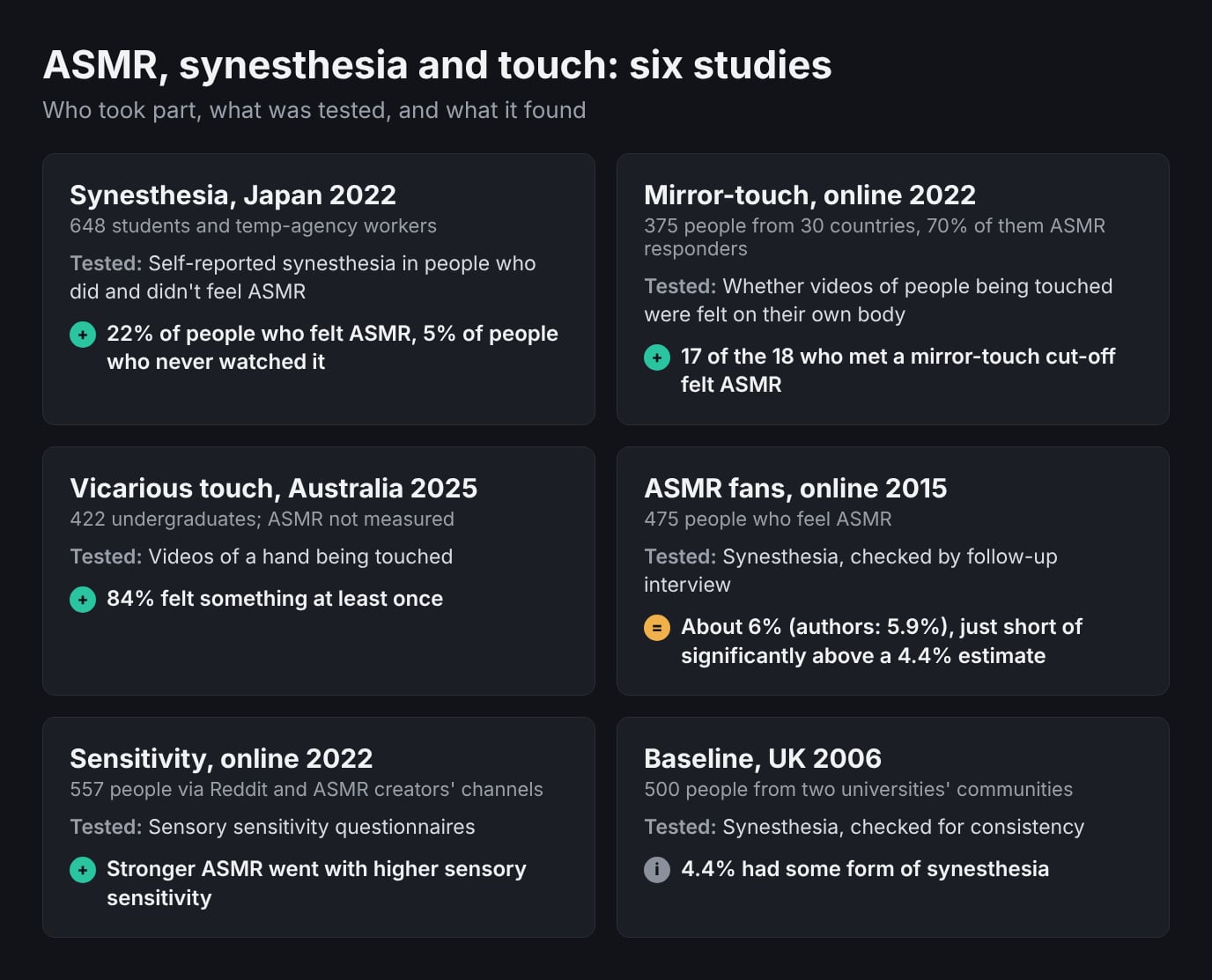
Six studies on ASMR, synesthesia and feeling touch you can see:
What is synesthesia?
In synesthesia, a stimulus in one sense brings on an experience in another: a letter seen as a colour, a day of the week with its own colour, a sound with a colour or shape. Researchers test for it by checking that a person’s pairings stay consistent over time.
It is not rare. In a 2006 study in Perception, Simner and colleagues tested 500 people recruited from the communities of Edinburgh and Glasgow universities, checking reports for consistency, and found some form of synesthesia in 4.4%. The most common kind was coloured days of the week.
Bottom line: Synesthesia is a consistent pairing between senses, found in roughly 4 in 100 people in a tested UK sample.
How common is synesthesia in people who feel ASMR?
In 2015, Barratt and Davis (PeerJ) surveyed 475 people who experienced ASMR, recruited through ASMR groups on Facebook and Reddit. Synesthesia was reported by 35 and confirmed by follow-up interview in 29; the authors give a prevalence of 5.9%, against a general-population estimate of 4.4%, a gap that “fell slightly short of being significantly higher”.
In 2022, Poerio, Ueda and Kondo (Frontiers in Psychology) surveyed 648 people in Japan: 247 college students and 401 working adults recruited at random through a temp agency, so not a group of ASMR fans. People answered yes-or-no questions about seven kinds of synesthesia, without the consistency tests used in the UK study.
The results split three ways:
- People who watched ASMR and felt it: 33 of 152 (22%) reported some synesthesia.
- People who watched ASMR but didn’t tingle: 10 of 91 (11%).
- People who had never watched ASMR: 21 of 405 (5%).
The “four times” figure compares the first and last groups; against people who watched without tingling, it is about twice. Looked at the other way, “over half of those identifying as synesthetes also experience ASMR”. The authors also tentatively suggest that about one in five people experience ASMR, a figure they say needs checking with random sampling; the science behind ASMR covers it in more detail.
Two cautions. Synesthesia here was self-reported, so some answers may not hold up under testing, and the 5.9% and 22% figures come from different questions and samples, so they are not a trend. Most people who tingled, 78% in the Japanese survey, reported no synesthesia at all.
Bottom line: In a general Japanese sample, people who felt ASMR reported synesthesia about four times as often as people who had never watched it, and about twice as often as people who watched without tingling.
Why researchers don’t call ASMR synesthesia
If the two overlap so much, why not file ASMR under synesthesia? Two of the papers give one reason each.
The first is what the experience feels like. In synesthesia, Barratt and Davis write, a trigger brings “knowledge or sensation of a certain concurrent”, such as a colour. ASMR’s tingle, they note, “is described in a very physical sense”. Judged on the tingle alone, they write, “we could with near certainty say that ASMR is not a subtype of synaesthesia”, though they add that this “neglects the presence of positive emotions which accompany the tingling sensation”.
The second is context. Poerio and colleagues note that synesthesia is often considered involuntary or automatic, while “ASMR appears to be more affected by contextual factors”. They suggest ASMR “may best be considered a heightened or exaggerated cross-modal correspondence related to hedonic touch”, while not ruling out that it could be an as yet unclassified form of synesthesia.
A 2023 review in Consciousness and Cognition (Mahady, Takac and De Foe, read from its abstract) considered frisson, synesthesia and misophonia as “related, but distinctly unique” phenomena alongside ASMR.
Bottom line: ASMR’s tingle is described as a physical feeling and seems to depend more on context than synesthesia does. The researchers who compared them call them similar but different.
What is mirror-touch synesthesia, and is it linked to ASMR?
People with mirror-touch “report experiencing tactile sensations on their own body when seeing another person being touched”, in the words of Ward, Schnakenberg and Banissy (Cognitive Neuropsychology, 2018).
In 2022, Gillmeister, Succi, Romei and Poerio (Consciousness and Cognition) tested whether it was more common in people who feel ASMR. They surveyed 375 people from 30 countries, 263 of them (70%) ASMR responders, recruited through ASMR groups on Facebook, Twitter, Reddit, creators’ channels and a UK university’s mailing list and participant pool. Each watched short videos of people being touched and said whether they felt anything on their own body.
Eighteen people met the authors’ cut-off for mirror-touch: feeling something on at least four of six videos of a person being touched, a threshold the authors derived by reanalysing Ward and colleagues’ screening data. “Seventeen of the 18 were ASMR-responders”, which is 6.5% of the 263 responders, against 1 of 112 non-responders. On average, responders’ mirror-touch scores were more than twice as high.
The cautions matter here. The non-responder group was small and its figure rests on one person. The authors note that their recruitment methods may have produced selection bias. And 93.5% of the responders did not meet the cut-off: feeling ASMR does not mean having mirror-touch.
Mirror-touch is sometimes linked with empathy. Ward and colleagues found it went with higher emotional empathy, but other measures of empathy were “normal-to-low”. Gillmeister’s survey did not measure empathy.
Bottom line: In one online survey, almost everyone who met a mirror-touch cut-off was an ASMR responder, but most responders did not meet it.
Can you feel touch from watching an ASMR video?
In a study published in Scientific Reports in 2025, Smit, Crossley, Zopf and Rich asked 422 undergraduates at Macquarie University in Sydney to watch short videos of a hand being touched, from gentle strokes to painful pressure. After each, they reported whether they felt anything themselves.
“A surprisingly large majority (84%) of participants reported vicarious sensations”, the authors write, meaning at least one sensation across the videos. Vicarious touch was more common in women than men. Their conclusion: the results “challenge the traditional view that conscious vicarious touch experiences are a rare phenomenon”.
This study measured no ASMR, and 84% is the share who felt something at least once, not the share who feel every touch they see. The only paper here that compared responders with non-responders on felt touch is the mirror-touch survey above. (The ASMR triggers guide covers touch-related triggers.)
Bottom line: In a large student sample, most people felt something at least once while watching a hand being touched. The study did not measure ASMR, so it cannot say how this relates to ASMR’s tingle.
Are people who feel ASMR more sensitive?
Two findings point toward a shared sensitivity. In Gillmeister’s survey, responders reported slightly stronger positive reactions to social touch than non-responders, though the authors say “the balance of evidence for this was not strong”. They reported no greater reactivity to negative social touch, a null result the authors found well supported.
A preregistered online study by Poerio, Mank and Hostler (Journal of Research in Personality, 2022), with 557 people recruited “via Reddit and the social media channels of ASMR video creators”, proposed that ASMR may be underlain by “individual differences in sensory sensitivity to exteroceptive and interoceptive cues”, meaning the outside world and signals from inside the body, and found that heightened sensory sensitivity predicted the presence and intensity of ASMR. Separately, Gillmeister and colleagues suggest that “atypical tactile sensory sensitivity might be a common core” of ASMR and mirror-touch, though none of these papers tested that link directly.
Bottom line: People with stronger ASMR tend to score higher on sensory sensitivity, and responders may like positive touch slightly more. Whether sensitivity explains the overlap with mirror-touch is a suggestion, not a finding.
What the research still doesn’t settle
- Self-report. The ASMR surveys relied on what people said they felt. Only the 2006 UK study and Barratt and Davis’s follow-up interviews checked synesthesia claims.
- Different samples. The Japanese survey reached students and temp workers; the mirror-touch survey people recruited online, 70% of them responders; the vicarious-touch study Australian students. Their figures can’t be lined up against each other.
- Different cut-offs. Gillmeister’s survey counted mirror-touch as feeling something on four of six videos; the Japanese survey asked a single yes-or-no question. How many people “have” mirror-touch depends on which measure is used.
- Cause. All of these are associations from surveys. None shows that synesthesia or mirror-touch causes ASMR, or the reverse.
- The brain. None of the papers read for this post measured what the brain’s touch areas do while someone watches ASMR and feels a tingle.
If you feel touch when you watch
These are suggestions drawn from the studies above, not tested advice.
- It isn’t unusual, at least in one student sample. In the Australian student study above, 84% felt something at least once.
- Try visual-touch videos (not tested). If you feel brushes and hand movements on your own skin, videos where the creator works close to the camera may suit you more than sound-only tracks.
- If you don’t feel it, you are not alone. In the mirror-touch survey, most responders did not meet the four-of-six-videos cut-off. Sound-led triggers are worth trying alongside visual ones (not tested). Some dedicated apps (including Tingles ASMR: Relax & Sleep) offer both ASMR videos from featured creators and more than 230 ASMR and sleep sounds.
- Don’t self-diagnose. Feeling something when you watch touch is not a diagnosis of synesthesia or mirror-touch, which researchers identify with consistency checks and screening cut-offs.
ASMR probably isn’t synesthesia, but it keeps company with it. Whether a brush felt through a screen is the strong end of something most students in one study felt at least once is a question these papers leave open.
References
ASMR, synesthesia and mirror-touch
- Poerio, G. L., Ueda, M., & Kondo, H. M. (2022). Similar but different: High prevalence of synesthesia in autonomous sensory meridian response (ASMR). Frontiers in Psychology, 13, 990565. DOI: 10.3389/fpsyg.2022.990565
- Gillmeister, H., Succi, A., Romei, V., & Poerio, G. L. (2022). Touching you, touching me: Higher incidence of mirror-touch synaesthesia and positive (but not negative) reactions to social touch in Autonomous Sensory Meridian Response. Consciousness and Cognition, 103, 103380. DOI: 10.1016/j.concog.2022.103380
- Barratt, E. L., & Davis, N. J. (2015). Autonomous Sensory Meridian Response (ASMR): a flow-like mental state. PeerJ, 3, e851. DOI: 10.7717/peerj.851
- Poerio, G. L., Mank, S., & Hostler, T. J. (2022). The awesome as well as the awful: Heightened sensory sensitivity predicts the presence and intensity of Autonomous Sensory Meridian Response (ASMR). Journal of Research in Personality, 97, 104183. DOI: 10.1016/j.jrp.2021.104183
- Mahady, A., Takac, M., & De Foe, A. (2023). What is autonomous sensory meridian response (ASMR)? A narrative review and comparative analysis of related phenomena. Consciousness and Cognition, 109, 103477. DOI: 10.1016/j.concog.2023.103477
Synesthesia and vicarious touch
- Simner, J., Mulvenna, C., Sagiv, N., Tsakanikos, E., Witherby, S. A., Fraser, C., Scott, K., & Ward, J. (2006). Synaesthesia: The prevalence of atypical cross-modal experiences. Perception, 35(8), 1024–1033. DOI: 10.1068/p5469
- Ward, J., Schnakenberg, P., & Banissy, M. J. (2018). The relationship between mirror-touch synaesthesia and empathy: New evidence and a new screening tool. Cognitive Neuropsychology, 35(5–6), 314–332. DOI: 10.1080/02643294.2018.1457017
- Smit, S., Crossley, M. J., Zopf, R., & Rich, A. N. (2025). Characteristics of vicarious touch reports in a general population. Scientific Reports, 15, 33458. DOI: 10.1038/s41598-025-03194-2


