
If you use ASMR to fall asleep, you may not look at it at all: the phone goes face down, your eyes close, and only the sound is left. Yet ASMR videos are made to be watched.
So does the picture matter? A handful of lab experiments have tested it, by playing the same sounds with and without the video, or with a video that doesn’t match.
The evidence that the picture adds anything is thin and mixed. In one randomised test, people who watched rated tingles higher than a separate group who only listened. A scanner study found no difference in tingling or relaxed mood after 30-second blocks, and none of the studies found for this post tested sleep.
Is ASMR better with video or audio only? The short answer
- Watchers rated tingles higher. In a randomised lab experiment, 30 college students heard brushing and tapping sounds. Those who also saw the video rated their tingles higher, on average, than those shown a blank screen.
- Not every study agrees. In a brain-scanning study of 30 people who had watched ASMR but never felt tingles, tingling and relaxed-mood ratings did not differ between video and sound alone.
- Sound alone still works. Most people new to ASMR (22 of 30) agreed they felt a tingling mood after audio-only ASMR; 8 of 30 did after classical music.
- Pictures alone can work, weakly. A small preprint found that silent ASMR clips sometimes triggered ASMR, though less often and less strongly than sound.
- Sync matters. Video running seconds out of sync was rated less pleasant than in-sync video, and in a VR test, sync raised intensity only when the action was filmed from the viewer’s point of view.
- Tingles are not sleep. These studies rated tingles, pleasantness and, in one case, relaxed mood after short clips; none tested sleep.
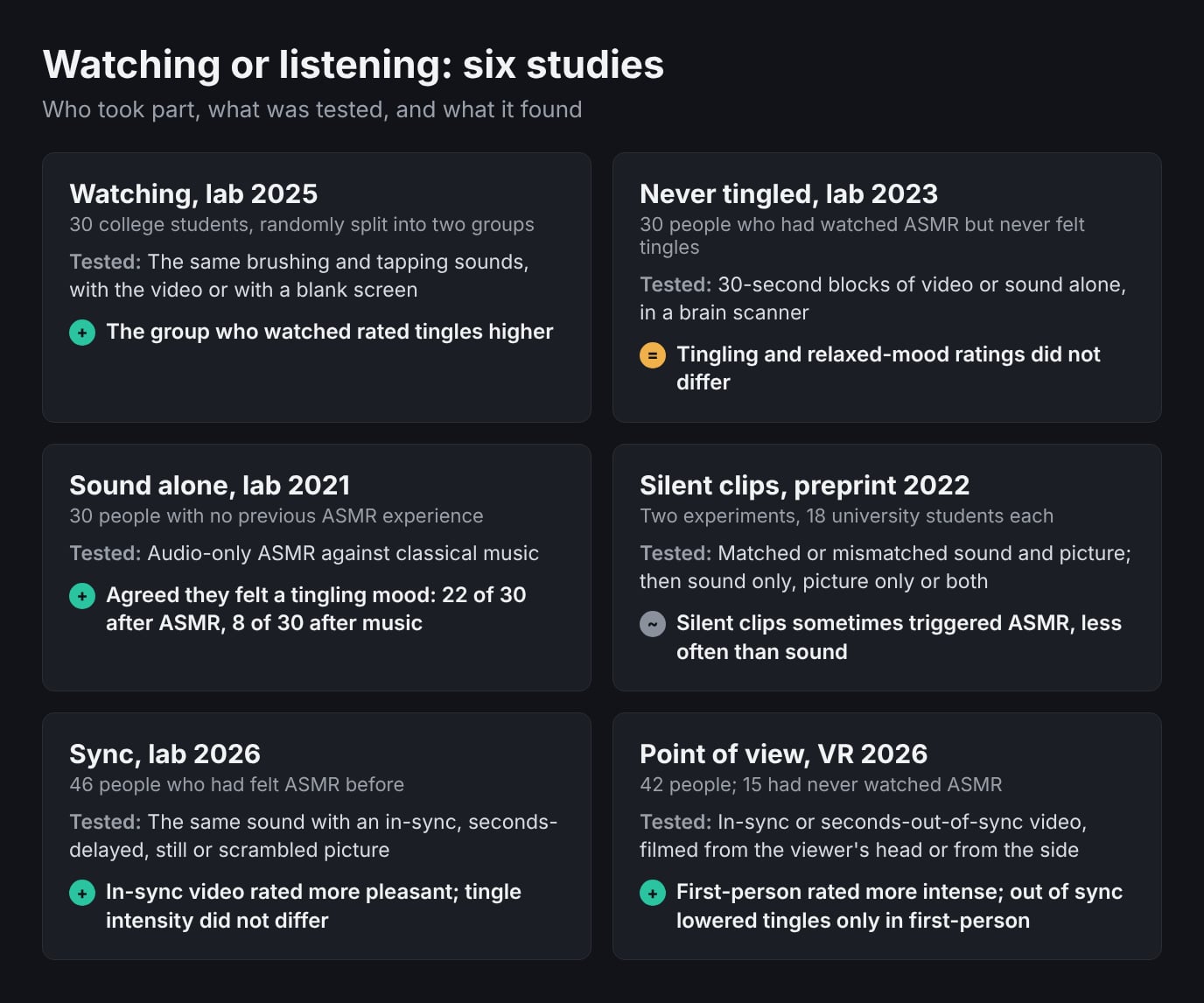
Six studies on watching versus listening, with what each tested and found:
Does ASMR work better with video?
One randomised test comes from a 2025 paper in Neuroscience of Consciousness. Hozaki, Ezaki, Poerio and Kondo randomly assigned 30 college students to one of two groups of about 15. Both groups heard the same five two-minute ASMR clips on headphones, mostly binaural brushing and tapping with no voices and no faces. One group watched the videos; the other “heard the same sounds” while looking at a blank screen.
People rated their tingles continuously while the clips played, on a scale from 0 (none) to 3. The group who watched averaged 1.36; the group who only listened averaged 0.96. A rating on a 0 to 100 scale, given afterwards, showed the same gap (69.0 against 49.9). The authors read this as “an additive effect through sensory processing”.
Two cautions. The groups were made up of different people, so this shows that watchers rated tingles higher than listeners did, not that adding the video raised anyone’s own tingles. And the clips had no whispering and no faces, by design, so the result may not carry over to whispered roleplays where the face is the point.
A 2023 brain-scanning study in Frontiers in Neuroscience came out differently. Sakurai and colleagues played 30 people aged 19 and older their preferred one of five ASMR types, in 30-second blocks, sometimes as video and sometimes as sound only, with a white cross on a black screen to look at. Afterwards, ratings of relaxed mood and tingling mood did not differ between the two. But the participants “had viewed ASMR videos but had never experienced tingling”, and the authors note that 30 seconds may have been too short to change mood. (The ASMR triggers guide covers what the scans showed.)
A 2025 conference abstract from Hozaki’s group, which gives no sample size, reports that auditory-only stimuli were rated more unpleasant than audiovisual or visual-only ones. This post could not find it published as a full paper.
Bottom line: In one randomised test, people who watched rated tingles higher than people who listened. In a scanner study of people who had never tingled, ratings did not differ.
Can ASMR work with sound alone, or with your eyes closed?
With sound alone, yes. In Hozaki’s experiment, the group who only listened still gave tingle ratings above zero on average, just lower than the group who watched. None of these studies had people close their eyes, though: the listeners looked at a blank screen or a cross.
An earlier study shows sound working on its own more plainly. In 2021, Sakurai and colleagues (Frontiers in Behavioral Neuroscience) played 30 people with no previous experience of ASMR’s tingles either audio-only ASMR or classical music. After the ASMR, 22 of the 30 agreed or highly agreed that they felt a tingling mood; after the music, 8 did. Ratings of comfort did not differ significantly between the two.
Screens may not even be the most common route. Introducing a 2024 study of research priorities in Multisensory Research, Hostler and colleagues note that ASMR is “not just elicited by audiovisual triggers but also, and perhaps most commonly, from touch”. That is the authors’ summary of earlier work, not a result of their own study.
Bottom line: Sound alone was enough for tingle ratings above zero on average, and for most people new to ASMR to agree they felt a tingling mood. Eyes-closed listening was not tested.
Can visual ASMR work without sound?
Some people say they get tingles from just watching, with the sound off. One preprint, not peer reviewed when it was posted, tested this. Maeno and Kajimura (2022) ran two experiments, each with 18 university students who knew what ASMR was.
In the second, people saw clips as sound only, picture only, or both. The silent clips triggered ASMR less often and less strongly than the sound did, but they did trigger it: “the visual trigger has the capability to induce ASMR by itself,” the authors write. When ASMR came from a silent clip, it also came sooner. The clips that frequently brought on ASMR were “about object manipulation without person”.
The first experiment paired sounds with matching or mismatched pictures. ASMR “was significantly more frequent in the matched condition than in the mismatched condition”.
Bottom line: In a small preprint, silent ASMR clips worked for some people, but less often than sound did, and matched pictures beat mismatched ones.
Why POV ASMR may work better: in sync and aimed at you
In point-of-view (POV) ASMR, the creator works on the camera as if it were the viewer’s head. A 2026 study gives the format some support.
Sakakihara and Kitada (Frontiers in Psychology, 2026) ran two preregistered experiments, approved by an ethics committee at Kobe University. In the first, 46 people who had experienced ASMR before watched 15- to 20-second clips of an actor, face not shown, brushing, cutting hair and doing other things around a dummy head. The sound was the same every time, but the picture was either in sync, delayed by two to five seconds, a still frame or a scrambled mosaic. In-sync video did not raise tingle intensity, but “the Synchronous condition was rated significantly more pleasant than the Asynchronous condition”, and more pleasant than the mosaic.
In the second experiment, 42 people wore a VR headset and watched about a minute of binaural recordings: a glass bottle, a newspaper, tape, paper cutting. The camera sat either at the dummy head, so the actions came at the viewer, or off to the side, watching the actor work on the dummy head. Twenty-seven of the 42 had experienced ASMR before; 15 had never watched ASMR videos.
Two results. First-person view was rated more intense overall. And sync mattered for intensity “only when participants observed the actions from a first-person perspective”: with sound and picture several seconds apart, tingles were rated weaker when the actions came at the viewer, but not when they were seen from the side. In-sync video was rated more pleasant from both viewpoints. The authors suggest that “participants may perceive themselves as the target of another’s action”, though they note that first-person view brought several things together, including closeness and attention, which the study could not pull apart.
An undated poster from researchers at Linköping University and the University of Skövde, hosted by the Max Planck Institute for Human Cognitive and Brain Sciences, points the same way. It reports higher tingle ratings for videos in which the actor’s attention seemed aimed at a viewer outside the frame than for videos in which it stayed on something in the shot. Sakakihara and Kitada cite a 2025 study by Jones and colleagues that compared the same two kinds of video; this post could not open it.
Bottom line: In-sync video was rated more pleasant. When the action was aimed at the viewer, keeping it in sync also kept the tingles stronger.
Is ASMR video or audio better for sleep?
This is the question many listeners actually have, and the studies above don’t answer it.
Most of them rated tingles and pleasantness. Only one compared relaxed mood between watching and listening: Sakurai’s 2023 scanner study, which found no difference after 30-second blocks, in people who had never tingled. Tingles and calm are different things. In a 2024 experiment, people who feel ASMR still tingled after a frightening clip, but rated it with lower positive valence than a separate group shown a relaxing clip, as the post on why some people hate ASMR describes.
Hozaki’s team also measured pulse rate: ASMR videos lowered it more than nature videos did. But both were watched; the audio-only group was not part of that test. None of the studies found for this post compared watching with listening at bedtime, over a full-length video, or for how fast people fell asleep.
So for sleep, there is no evidence either way. Watching may bring more tingles; listening may suit bedtime; neither has been shown to help sleep more.
Bottom line: One study compared relaxed mood after 30 seconds and found no difference. Which format helps people sleep is untested.
What the research still doesn’t settle
- Whispering and faces. Two of these studies deliberately left out faces or voices: Hozaki’s clips had no voices or faces, and Sakakihara’s first experiment hid the actor’s face. Whispered roleplay, where the creator’s face and voice carry the video, may behave differently.
- Real viewing. Clips ran from 15 seconds to a few minutes, in labs or VR headsets, not full-length videos watched at home.
- Size and samples. Most experiments here had between 18 and 46 people, mostly young adults with an average age near 20; two of the studies describe them as university or college students. The Japanese studies are by authors at universities in Japan; their methods sections do not say where participants were recruited.
- Different people, different needs. One study used only people who had never tingled; another, only people who had. Results could differ between the two.
- Within one person. The randomised evidence that watchers rated tingles higher compared two separate groups. A test of the same people with and without video, over full-length sessions, would say more.
Watching or listening: how to choose
These are suggestions drawn from the studies above, not tested advice.
- Watch to find your triggers. If you’re new to ASMR or looking for what works, the video may make tingles easier to notice.
- Listen when you want to switch off. Audio-only tracks and ASMR podcasts were not tested as such, but sound alone still produced tingle ratings in the studies that tested it, and the one study that rated relaxed mood found no difference after 30 seconds. One conference abstract, though, rated sound-only clips more unpleasant.
- If you watch, watch in sync. Video running seconds out of sync was rated less pleasant. If the picture lags badly, sound alone may be better.
- Try POV. If third-person videos do little for you, videos filmed as if aimed at you may be worth a try.
- Use headphones either way. Hozaki’s experiment played binaural sounds on headphones; the triggers guide explains why that matters.
Some dedicated apps (including Tingles ASMR: Relax & Sleep) offer both ASMR videos and more than 230 ASMR and sleep sounds you can build into your own mixes.
You don’t need to watch ASMR for it to work. Watchers rated tingles higher in one test, but listening alone hasn’t been shown to cost you the calm.
References
Watching versus listening
- Hozaki, D., Ezaki, T., Poerio, G. L., & Kondo, H. M. (2025). More relaxing than nature? The impact of ASMR content on psychological and physiological measures of parasympathetic activity. Neuroscience of Consciousness, 2025(1), niaf012. DOI: 10.1093/nc/niaf012
- Sakurai, N., Nagasaka, K., Takahashi, S., Kasai, S., Onishi, H., & Kodama, N. (2023). Brain function effects of autonomous sensory meridian response (ASMR) video viewing. Frontiers in Neuroscience, 17, 1025745. DOI: 10.3389/fnins.2023.1025745
- Sakurai, N., Ohno, K., Kasai, S., Nagasaka, K., Onishi, H., & Kodama, N. (2021). Induction of relaxation by autonomous sensory meridian response. Frontiers in Behavioral Neuroscience, 15, 761621. DOI: 10.3389/fnbeh.2021.761621
- Maeno, A., & Kajimura, S. (2022). The role and power of visual trigger on the experience of Autonomous Sensory Meridian Response (ASMR). Research Square (preprint, not peer reviewed when posted). DOI: 10.21203/rs.3.rs-2384295/v1
- Hozaki, D., Okita, H., Amano, N., Haginiwa, K., & Kondo, H. (2025). How visual context shapes emotional responses to autonomous sensory meridian response. Abstract, APS Global Psychological Science Summit 2025 (conference abstract). Link
Sync and point of view
- Sakakihara, N., & Kitada, R. (2026). First-person visual perspective enhances audiovisual synchrony effects in autonomous sensory meridian response. Frontiers in Psychology, 17, 1740614. DOI: 10.3389/fpsyg.2026.1740614
- Jones, M. R., Daniels, A., Igelström, K., Suvilehto, J., & Morrison, I. (n.d.). Tingle-eliciting properties of pleasant, calming and potentially socially relevant audiovisual stimuli: the Autonomous Sensory Meridian Response (ASMR). Poster, hosted by the Max Planck Institute for Human Cognitive and Brain Sciences. PDF
Context
- Leung, W. L., & Romano, D. M. (2024). Autonomous sensory Meridian response as a physically felt signature of positive and negative emotions. Frontiers in Psychology, 15, 1183996. DOI: 10.3389/fpsyg.2024.1183996
- Hostler, T. J., Poerio, G. L., Nader, C., Mank, S., Lin, A. C., et al. (2024). Research priorities for autonomous sensory meridian response: An interdisciplinary Delphi study. Multisensory Research, 37(6–8), 499–528. DOI: 10.1163/22134808-bja10136


