
In 2024, a set of three advertising experiments tested ASMR in ads. Among people who feel ASMR’s physical sensations, it had a positive effect. Among the wider population, it had “a generally negative effect” on what people thought of the ad.
That split runs through the research on why some people dislike ASMR. In one survey of 648 students and working adults, about one in five were ASMR responders, and for the rest the videos may not be just dull: in a German study, non-tinglers scored lower on positive mood and relaxation than a separate walking-tour group.
Misophonia, the usual explanation, may cover only part of it, and those who feel ASMR score higher on misophonia, not lower. Two other things may matter: which sounds a video uses, with eating standing out in one study, and what the listener takes a sound to be.
Why do some people hate ASMR? The short answer
- Most people may not tingle. About one in five were responders in the survey above. For the rest, an ASMR video is just a stranger whispering.
- For non-tinglers it is not neutral. German students who said they did not feel ASMR reported a less positive mood and less relaxation after ASMR videos than a separate group shown walking-tour videos.
- Eating sounds stand out. In one online experiment, an eating video scored higher on negative mood than most of the 13 trigger types tested. In a UK survey, for each of slurping, sniffing, chewing gum and loud breathing, fewer than one in four people felt nothing at all.
- Misophonia may be part of it. In one UK estimate, about 18% of people experience misophonia, strong reactions to sounds such as chewing, to an extent that causes significant burden.
- Meaning matters. In lab tests, a sound became more or less pleasant depending on what people thought it was.
Six studies on why ASMR can feel bad, with what each tested and found:
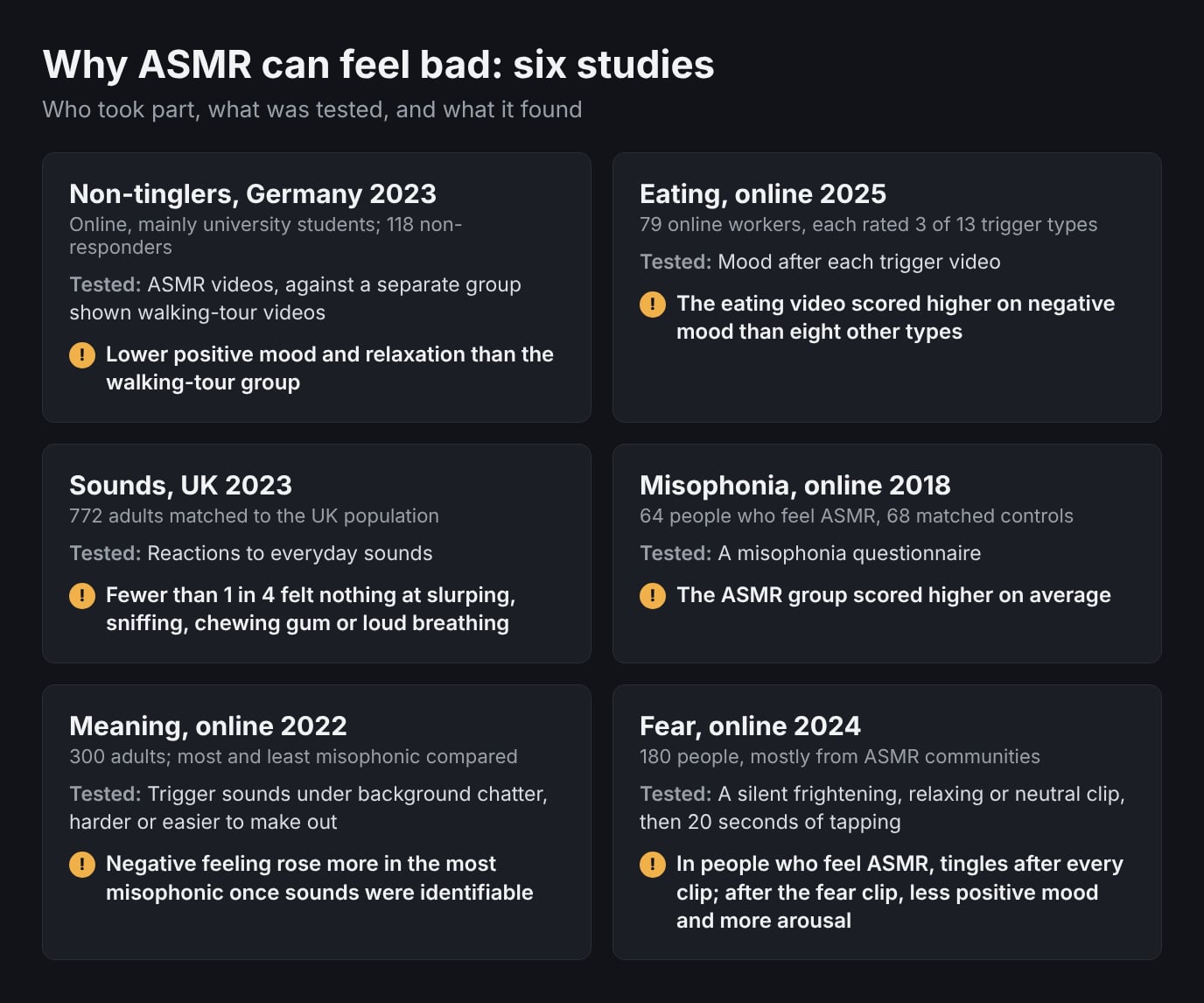
Most people may not feel ASMR, and for them it isn’t neutral
Estimates of how many people feel ASMR depend on who is asked. In a 2022 study in Frontiers in Psychology, Poerio, Ueda and Kondo surveyed 648 students and working adults, the working adults recruited at random through a temp agency, and estimated that about 20% are ASMR responders. The authors call the figure tentative and say it needs checking with random sampling. (The science behind ASMR covers who feels it in more detail.)
The more telling result is what happens to everyone else. Lohaus and colleagues (PLOS ONE, 2023) asked mainly German university students to watch ten three-minute videos online. One group of 205 watched ASMR videos. A second group of 96, recruited separately about two months later, watched walking-tour videos instead. Afterwards, the 118 ASMR viewers who said they did not feel ASMR scored lower on positive mood than the walking-tour group (2.14 against 3.11) and lower on relaxation (2.78 against 3.57).
Two cautions. The groups were not randomised, and the paper tested responders, non-responders and the walking-tour group together rather than this pair alone. But the gap points one way: for people who don’t feel it, ASMR does not seem to be neutral filler.
Bottom line: For people who don’t feel it, ASMR videos were followed by less positive mood and less relaxation than walking-tour videos were for a separate group.
Is hating ASMR misophonia?
For some people the reaction goes beyond boredom, and misophonia may be part of the reason. A 2022 consensus definition, agreed by a 15-member committee (Swedo and colleagues, Frontiers in Neuroscience), describes it as “a disorder of decreased tolerance to specific sounds or stimuli associated with such sounds”. The committee notes that “sounds associated with oral functions are among the most often reported misophonic trigger stimuli”: chewing, eating, lip smacking, slurping, coughing, throat clearing and swallowing.
Two of those, eating and lip smacking, are also ASMR triggers. A 2025 study, below, tested eating as a trigger alongside whispering and tapping, and lip smacking is a staple of mouth-sound videos.
How common is misophonia? In 2023, Vitoratou and colleagues surveyed 772 adults online, in a sample stratified to match the UK population by sex, age and ethnicity, and published the results in PLOS ONE. They estimated that 18.4% of people experience misophonia “to an extent that it causes significant burden”. The authors stress that their questionnaire “was not intended to be a clinical diagnosis of misophonia at a disorder level”, so this measures how much sound sensitivity affects daily life, not how many people have a disorder.
The same survey shows which sounds people react to. For teeth sucking, dog barking, slurping, chewing gum, snoring, sniffing, coughing and loud breathing, fewer than 25% of participants reported no feeling at all. For normal breathing, yawning and footsteps, more than 80% felt nothing. The most common negative reaction was irritation, except for loud chewing, where disgust was reported more often (39%).
Bottom line: Misophonia may explain part of it, and some of its most-reported triggers, eating among them, are also ASMR triggers. The 18% figure measures burden, not a diagnosis.
ASMR fans score higher on misophonia, not lower
It would be tidy if ASMR and misophonia were opposites. They are not. In a 2018 online study in PeerJ, Janik McErlean and Banissy compared 64 people who reported ASMR with 68 age- and gender-matched controls. On average, the ASMR group scored higher on all the scales of a misophonia questionnaire. More of them scored at or above its cut-off for symptoms (36% against 22%), though that difference was not statistically significant. “Individuals reporting ASMR experience have elevated levels of misophonia,” the authors conclude.
A 2024 study in Philosophical Transactions of the Royal Society B by Mednicoff and colleagues, read from its abstract, fits with this: people’s reactions to misophonia videos were correlated with their reactions to ASMR videos and to music-chills videos. The authors suggest this “could reflect a general phenotype of stronger emotional reactivity to meaningful sensory inputs”, an idea the science behind ASMR explores. Both studies show the reactions go together, not that one causes the other.
Is it the hands? Misokinesia
Some people say it is the visuals that grate: the tapping fingers, the slow repetitive hand movements. There is a name for a related sensitivity. In three studies with 4,100 participants in total, mostly university students plus an online adult sample, Jaswal, De Bleser and Handy (Scientific Reports, 2021) found that about a third reported “some degree of sensitivity” to seeing others fidget, which they call misokinesia. The paper does not mention ASMR, so linking the two is an inference, not a finding.
Do eating sounds stand out?
One 2025 study set 13 ASMR triggers against each other, and eating was the one that stood out. In it, Bollinger and colleagues (Technology, Mind, and Behavior) had 79 online participants, recruited on Amazon Mechanical Turk, each watch videos of three of 13 trigger types and rate their mood. The paper does not say the participants were screened for ASMR. For the most part, participants “did not experience these videos as unpleasant at all”. But the difference between videos in negative mood “was completely driven by the eating video”, which scored higher on negative mood than eight of the other trigger types, including whispering and tapping. Eating videos also produced the lowest ASMR scores.
One caution: each person saw only three trigger types, so each type had fewer than 20 ratings on average.
Bottom line: In the one head-to-head test, eating was the trigger that drove the negative-mood differences, and it also produced the lowest ASMR scores.
It may be what the sound means, not the sound itself
Some of the dislike may not be about the waveform at all. In two small lab experiments with undergraduates at Carnegie Mellon University in Pittsburgh (39 and 21 participants), Heller and Smith (Frontiers in Psychology, 2022) played everyday sounds, some of them slurping, chewing and sniffling. In the second experiment they degraded the sounds so that people sometimes misheard what they were. When a sound was misheard as something more pleasant, or less pleasant, its pleasantness rating moved the same way. The evidence is thin, since only a handful of sounds were misidentified and the effect was only marginal in the first experiment, but every case went in the predicted direction.
A larger online study found something related. Savard and colleagues (Frontiers in Neuroscience, 2022) played trigger, unpleasant and neutral sounds to 300 adults under background chatter, at levels that made them harder or easier to make out, and compared the 66 most and 68 least misophonic. Both groups recognised the trigger sounds as unpleasant, but in the most misophonic, negative emotion rose more steeply “once the sounds became identifiable”. The authors suggest that “learning and higher-order evaluation of sounds play an important role in misophonia”.
Neither study tested ASMR. But they suggest one reason a whisper that soothes one listener can feel intrusive to another: it may matter whether you hear a soft texture or a stranger’s mouth an inch from your ear.
Bottom line: How unpleasant a sound feels depends partly on what you think it is. That is an inference for ASMR, not a tested finding.
Can ASMR make you anxious or uncomfortable?
Even people who feel ASMR do not always find it calming. In a 2024 online experiment in Frontiers in Psychology, Leung and Romano showed 180 people, recruited mostly from ASMR communities on Reddit and by word of mouth, a silent video clip meant to make them feel afraid, relaxed or neutral, then played 20 seconds of tapping. Among those who reported being able to feel ASMR, tingles happened after every kind of clip, including the frightening one, and were about as strong. What changed was the mood that came with them: after the fear clip, they reported less positive feeling and more arousal than after the relaxing clip. ASMR, the authors write, “does not always induce relaxation”.
The setup was artificial, the frightening clips were not checked to see whether they actually caused fear, and the study did not ask about unpleasant tingles directly. But it fits what some listeners describe: the same physical sensation can come with calm or with unease, depending on what else is going on.
Bottom line: Tingles are not the same thing as calm. In one experiment they came with unease after a frightening clip. The study measured mood and arousal, not anxiety.
Why ASMR ads put some people off
Back to the advertising studies. Cohen, Sands, Campbell and Mavrommatis (Journal of Retailing and Consumer Services, 2024) ran three experiments across different kinds of products and brands. The abstract adds one detail: “Notably, negative brand attitudes were observed only with unknown brands.” The full paper was not available for this post, and the abstract gives no sample sizes, so the size of the effect is unknown.
Bottom line: ASMR in an ad helped only with people who feel ASMR, and it hurt attitudes to the brand only when the brand was unknown.
What the research still doesn’t settle
- How common hating ASMR is. None of the studies found for this post measured it directly in a general-population sample.
- Which part does the damage. None of these studies separated the sound, the close-up visuals and the intimacy of being whispered at, to see which one puts people off.
- Size. Several of these studies are small. The eating result rests on fewer than 20 ratings per trigger type on average, and the identification effects on a handful of sounds.
- Who took part. The samples were mostly students, online workers or ASMR community members, largely from Europe and North America.
- Cause and effect. The misophonia links come from questionnaires and reaction ratings. They show the traits travel together, not why.
If ASMR bothers you
These are suggestions drawn from the studies above, not tested advice.
- You are not unusual. If about one in five people feel ASMR, most people don’t.
- Try a version without mouth sounds. If it is the chewing or lip smacking that grates, tapping, brushing and rain leave mouth sounds out altogether. Some dedicated apps (including Tingles ASMR: Relax & Sleep) let you build a mix from individual sounds.
- Try the sound without the video. If it is the tapping fingers and slow hand movements that grate, audio alone may be easier.
- Don’t force it. If ASMR does nothing for you, something else may calm you more.
Hating ASMR is not a failure to get it. Some of the sounds it relies on, like eating, are ones many people already react to.
References
ASMR studies
- Poerio, G. L., Ueda, M., & Kondo, H. M. (2022). Similar but different: High prevalence of synesthesia in autonomous sensory meridian response (ASMR). Frontiers in Psychology, 13, 990565. DOI: 10.3389/fpsyg.2022.990565
- Lohaus, T., Yüksekdag, S., Bellingrath, S., & Thoma, P. (2023). The effects of Autonomous Sensory Meridian Response (ASMR) videos versus walking tour videos on ASMR experience, positive affect and state relaxation. PLOS ONE, 18(1), e0277990. DOI: 10.1371/journal.pone.0277990
- Bollinger, M. R., Mulkey, L. L., Nguyen, P. V., & Perilloux, C. (2025). Hooked on a feeling: Psychological and physiological responses to autonomous sensory meridian response triggers. Technology, Mind, and Behavior, 6(4), 325–337. DOI: 10.1037/tmb0000177
- Leung, W. L., & Romano, D. M. (2024). Autonomous sensory Meridian response as a physically felt signature of positive and negative emotions. Frontiers in Psychology, 15, 1183996. DOI: 10.3389/fpsyg.2024.1183996
Misophonia and sound sensitivity
- Swedo, S. E., et al. (2022). Consensus Definition of Misophonia: A Delphi Study. Frontiers in Neuroscience, 16, 841816. DOI: 10.3389/fnins.2022.841816
- Vitoratou, S., Hayes, C., Uglik-Marucha, N., Pearson, O., Graham, T., & Gregory, J. (2023). Misophonia in the UK: Prevalence and norms from the S-Five in a UK representative sample. PLOS ONE, 18(3), e0282777. DOI: 10.1371/journal.pone.0282777
- Janik McErlean, A. B., & Banissy, M. J. (2018). Increased misophonia in self-reported Autonomous Sensory Meridian Response. PeerJ, 6, e5351. DOI: 10.7717/peerj.5351
- Mednicoff, S. D., Barashy, S., Vollweiler, D. J., Benning, S. D., Snyder, J. S., & Hannon, E. E. (2024). Misophonia reactions in the general population are correlated with strong emotional reactions to other everyday sensory–emotional experiences. Philosophical Transactions of the Royal Society B, 379(1908), 20230253. DOI: 10.1098/rstb.2023.0253
- Jaswal, S. M., De Bleser, A. K. F., & Handy, T. C. (2021). Misokinesia is a sensitivity to seeing others fidget that is prevalent in the general population. Scientific Reports, 11, 17204. DOI: 10.1038/s41598-021-96430-4
What a sound means
- Heller, L. M., & Smith, J. M. (2022). Identification of Everyday Sounds Affects Their Pleasantness. Frontiers in Psychology, 13, 894034. DOI: 10.3389/fpsyg.2022.894034
- Savard, M.-A., Sares, A. G., Coffey, E. B. J., & Deroche, M. L. D. (2022). Specificity of Affective Responses in Misophonia Depends on Trigger Identification. Frontiers in Neuroscience, 16, 879583. DOI: 10.3389/fnins.2022.879583
Advertising
- Cohen, J., Sands, S., Campbell, C., & Mavrommatis, A. (2024). Sonic sensations: Navigating the mixed outcomes of ASMR in retail advertising. Journal of Retailing and Consumer Services, 80, 103900. DOI: 10.1016/j.jretconser.2024.103900


