
A 2015 reader thread on ASMR University asked whether ASMR helps with focusing, and the replies pointed both ways. One reader found that after about ten minutes they became “much less frantic”. Another said it left them pretty unproductive. The top search results checked for this post still answer the question mostly with anecdotes.
A handful of experiments have now tested it, and the answer so far is not encouraging. The one controlled test of ASMR audio and demanding tasks that turned up for this post, a 2026 PhD dissertation from the University of Southern Mississippi, found no benefit on any task. The studies that do report gains tested ASMR as a short break, or had no comparison group, so their gains are hard to pin on ASMR. And research on distracting speech suggests that whispering you can understand may be a poor thing to have on while you study.
None of this says ASMR for studying is useless. It says the evidence for it as a focus aid is thin, and that the kind you pick probably matters.
Does ASMR help you focus? The short answer
- Listening to ASMR and demanding tasks: no benefit in the one controlled test found, which compared ASMR with white noise. It is a dissertation, read from its abstract only, and the abstract does not say whether the audio played during the tasks or before them.
- As a break: in 28 university students in China, reaction times improved more across a four-minute ASMR break than across the same point of a session with no break. By the end of the task the difference was only marginal, and none of the studies reviewed here compared the break with a quiet one.
- For memory: one small study found better scores after five minutes of nature sounds labelled ASMR, with no comparison group at all.
- For reading and study: a meta-analysis of background sound found that speech you can understand distracts readers most. A separate lab test of memory for letters found whispering slightly more disruptive than normal speech, for listeners who understood the language. Neither studied ASMR.
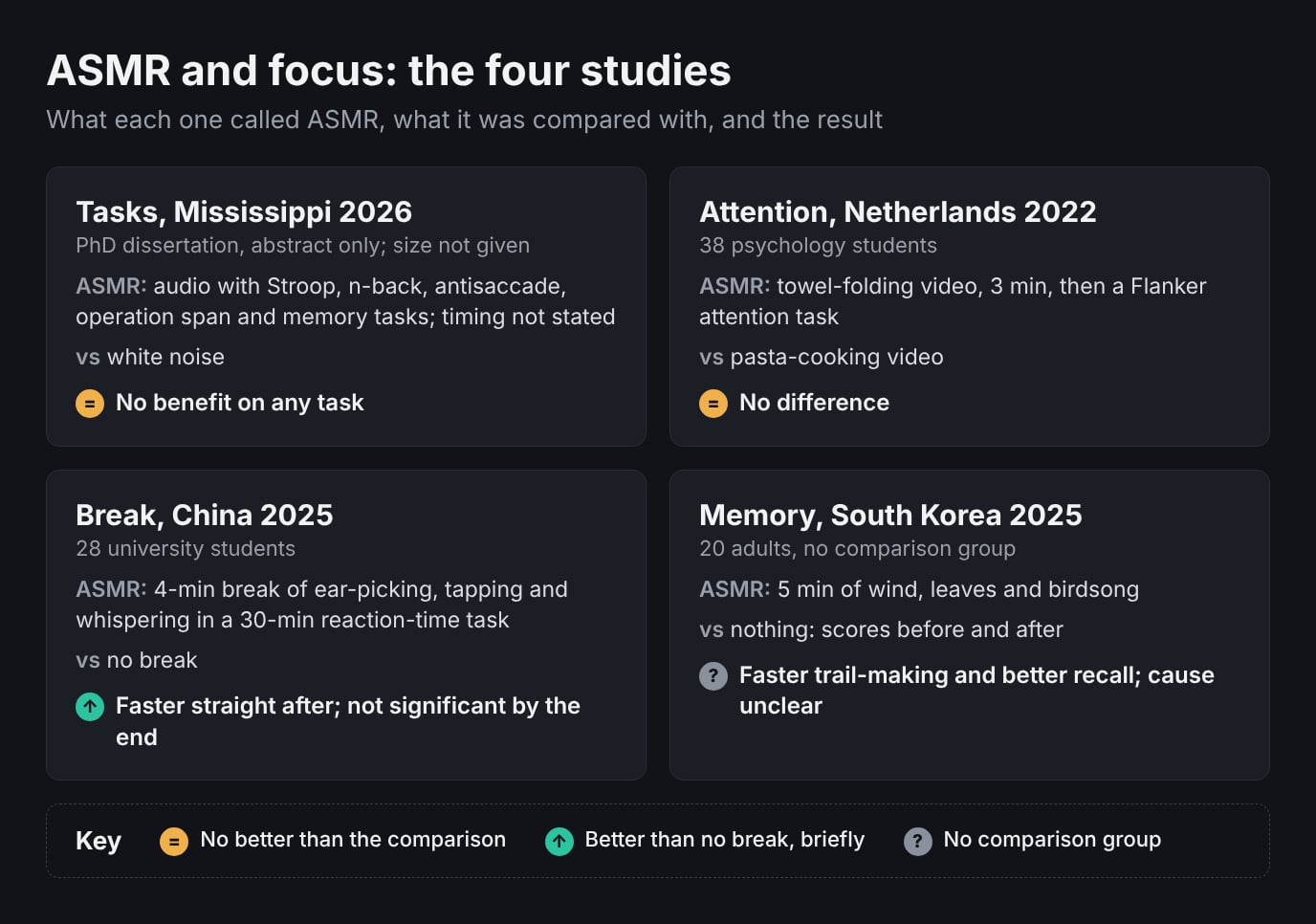
The four ASMR studies, with what each one tested and what it was compared with:
Does ASMR help you concentrate? The test against white noise
The most direct test is a 2026 doctoral dissertation by Mazela at the University of Southern Mississippi. It compared people who listened to ASMR audio with a control group who heard neutral white noise, on five demanding tasks: Stroop (naming ink colours while ignoring the word), n-back and operation span (two working-memory tests), antisaccade (looking away from a sudden target) and a two-list memory task. The abstract’s conclusion is flat: “Listening to ASMR audio did not enhance performance across any of the cognitive tasks.”
Four limits matter. A dissertation is not peer-reviewed in the way a journal article is. The full text is embargoed until May 2027, so this post rests on the abstract. The abstract gives no sample size, so nothing can be said about how large a benefit the study could have missed. And it does not say whether the audio played during the tasks, before them or in between.
An earlier lab study points the same way with a different design. Engelbregt and colleagues (Experimental Brain Research, 2022) showed 38 Dutch psychology students, 15 of whom felt tingles, a three-minute ASMR video of a woman folding towels and a similar-length control video of a man explaining how to make pasta, both played through an iPad speaker. After each video, participants did a Flanker task, a standard attention test in which you respond to a central arrow while ignoring the arrows around it. Neither accuracy nor reaction time differed after the two videos, and tinglers did no better than non-tinglers. Accuracy was close to the maximum for everyone, which may have left little room to show a difference.
The paper’s abstract still ends by suggesting that ASMR “is related to arousal and focused attention”. That comes from brain recordings: beta activity at one left temporal electrode rose during the ASMR video, which the authors suggest “may reflect improved focused attention”. They also note that “the notion of improved focused attention seems opposite to the absence of a relationship” with Flanker performance.
Bottom line: In both studies that compared ASMR with another sound or video and measured attention or memory, ASMR did no better.
Can an ASMR break help with mental fatigue?
One result is more encouraging, and it treats ASMR as a break. Si and colleagues (Frontiers in Human Neuroscience, 2025) had 28 students at Zhejiang University in China do a 30-minute vigilance task, pressing a button whenever a red dot appeared, on two separate days. On one day they worked straight through. On the other they stopped halfway for a four-minute ASMR recording of ear-picking, wood tapping and whispering.
Reaction times improved more across the break than across the same point of the no-break session. But “general beneficial effects were not observed”: by the end of the task, the reduction in reaction times was only marginal (p = 0.072 after correction). Participants were not screened for ASMR sensitivity, and how strongly they felt it made no significant difference to the results.
The bigger problem is the comparison. The other day had no break at all, so the study cannot separate ASMR from simply stopping for four minutes. The authors’ conclusion, that “ASMR provides immediate relief from mental fatigue”, goes further than that design can show. They note that the sample was small and “primarily composed of healthy college students”.
Bottom line: A short ASMR break beat no break, briefly. No study here tested whether it beats a plain four-minute rest.
Can ASMR improve memory?
The study with the boldest abstract has no comparison group. Wang and colleagues (Frontiers in Psychology, 2025) gave 20 Korean adults, all affiliated with Korea University or its medical centre, a trail-making test (joining numbered and lettered dots in order) and a five-word memory test, before and after a five-minute recording. The abstract says “Auditory ASMR stimulation improves executive and memory functions.”
The recording was “a 5-min segment of natural sounds—including wind, rustling leaves, and bird chirping”, played through an iPad’s built-in speakers. Afterwards, the trail-making test took about 5.4 seconds instead of 7.9, and people recalled about 4.8 of the five words instead of 3.9.
Nobody sat for five minutes in silence, or listened to something else, and then repeated the tests. The authors acknowledge the gains “may partially reflect practice effects rather than specific ASMR stimulation”, though they used different word lists to reduce that. They also write that “the absence of a control group limits causal inference”, and that they “did not perform subjective assessments to confirm whether participants experienced ASMR-specific sensations.”
This is the same problem the clinical-trials post found in therapy research: “ASMR” can mean birdsong in one study and towel folding in another.
Bottom line: The memory gain came after nature sounds, in a before-and-after test with no comparison group. It cannot show that ASMR improved anything.
Why whispering may be the wrong ASMR for studying
A 2018 Bayesian meta-analysis by Vasilev, Kirkby and Angele in Perspectives on Psychological Science pooled 65 studies and found that background noise, speech and music all had a small but reliable harmful effect on reading. The worst offenders: “Intelligible speech and lyrical music resulted in the biggest distraction.”
Whispering has been tested in a memory task. In 2024, Kattner and colleagues (Journal of the Acoustical Society of America) asked people to remember the order of letters on a screen while ignoring speech played in the background. Among 94 native German speakers in Potsdam, whispered German speech was slightly more disruptive than the same speech spoken normally, even though the whispers were a little quieter. Among 51 people who did not understand German, tested in England and Munich, the difference disappeared. Whispering “was more disruptive than voiced speech when participants understood the language”, the authors write. The effect was small: 53% of letters recalled in the right order with whispers against 55% with normal speech.
Neither study used ASMR, and Kattner’s task was memorising letters, not reading. So applying them to study ASMR is an inference, not a finding. But if the whispering is in a language you understand, that is the case Kattner found most disruptive.
Bottom line: Speech you can understand distracts readers most. In one memory task, whispered speech distracted a little more. If you study with ASMR, the no-talking kind looks the safer bet.
Does ASMR help with ADHD?
No study testing ASMR in people with ADHD turned up for this post. The evidence people may have in mind is about steady noise.
A 2024 meta-analysis by Nigg and colleagues in the Journal of the American Academy of Child and Adolescent Psychiatry pooled lab studies of white and pink noise in children and college-age young adults. For those with ADHD or ADHD symptoms, noise gave “a small but statistically significant benefit” on attention tasks (13 studies, 335 participants). For comparison groups without ADHD, “white and pink noise had a negative effect” (11 studies, 335 participants). That is noise, not ASMR, on lab tasks, and it suggests a steady background sound helps some people focus and hinders others.
Bottom line: There is no ASMR evidence for ADHD yet. The noise evidence is small and points different ways for different people.
Are people who feel ASMR better at focusing?
There is one trait finding that may cut both ways. In a 2020 survey in PeerJ, Janik McErlean and Osborne-Ford matched 124 people who experience ASMR with 124 who don’t, recruited through ASMR websites and a psychology student pool. The experiencers scored higher on absorption, which the authors describe as “the ability to get deeply immersed with the current experience accompanied by loss of reflective awareness”. They did not differ in mindfulness or in how intense their flow states were, though more of them reported experiencing flow at all. Whether people who feel ASMR are more mindful is disputed: a 2018 PeerJ survey by Fredborg, Clark and Smith, comparing ASMR forum members with a matched online panel, found higher trait mindfulness in those who experience ASMR.
Neither survey tested how well anyone studies. But the regular users interviewed in a 2023 UK study by Woods and Turner-Cobb, eight women studying psychology at one university, describe their focus as being on the ASMR itself. “I feel like I can just concentrate on that alone,” one said. “I’ll be focused on the video,” said another. If ASMR works for you by drawing you in, that is a reason to be careful about leaving it on while you need your attention elsewhere.
Bottom line: A trait survey and eight interviews hint that people who feel ASMR may get absorbed in it. If so, that would favour a break over a background, but nothing here tested it.
What the research still doesn’t settle
- Size. The ASMR studies here have 20, 28 and 38 participants, and the dissertation abstract gives no number. None has been repeated by another team, as far as this post found.
- Who took part. In the three studies that describe their participants, almost everyone was a university student or staff member, in the Netherlands, China or South Korea.
- Who responds. Engelbregt compared people who report feeling tingles with those who don’t on an attention task and found no difference. Mazela’s abstract reports only weak links between ASMR sensitivity and a few outcomes, Wang did not ask, and Si found that how strongly people felt ASMR did not change the results.
- The right comparison. None of the studies reviewed here compared an ASMR break with a quiet break, or tested no-talking ASMR against whispering while people read.
- Real studying. All of these used lab tasks (the dissertation abstract does not say how long they lasted). None measured revision, exam results or a working day.
If you want to try it
None of this is a tested protocol. These are suggestions drawn from the studies above.
- Try ASMR as a break before using it as a soundtrack. A few minutes between blocks of work is the one use where a comparison with another condition found any gain.
- Pick sounds without words for reading. Typing, writing, page turning or rain avoid the speech that distracts readers most. The study and focus sounds are built from that kind of trigger.
- Test it on yourself. The noise research found that the same background sound helped some young people and hindered others. Try a week of study sessions with it and a week without, and compare how much you get done.
Some dedicated apps (including Tingles ASMR: Relax & Sleep) let you build a mix from individual sounds, so you can keep whispering and roleplay out of a study session.
In the studies reviewed here, listening to ASMR has not shown it helps people focus. Its best case is as a short break, which was tested only against no break at all.
References
ASMR and attention, memory or fatigue
- Mazela, M. (2026). Exploring the Effects of ASMR on Attentional Control, Episodic Memory, and Working Memory Tasks. Doctoral dissertation, The University of Southern Mississippi (not peer-reviewed; full text embargoed until May 2027). Abstract
- Engelbregt, H. J., Brinkman, K., van Geest, C. C. E., Irrmischer, M., & Deijen, J. B. (2022). The effects of autonomous sensory meridian response (ASMR) on mood, attention, heart rate, skin conductance and EEG in healthy young adults. Experimental Brain Research, 240(6), 1727–1742. DOI: 10.1007/s00221-022-06377-9
- Si, Y., Sun, Y., Wu, K., Gao, L., Wang, S., Xu, M., & Qi, X. (2025). Effects of ASMR on mental fatigue recovery revealed by EEG power and brain network analysis. Frontiers in Human Neuroscience, 19, 1619424. DOI: 10.3389/fnhum.2025.1619424
- Wang, I.-N., Kim, H., Kim, H., Yoon, H.-J., Park, J.-S., Kim, J. B., & Kim, D.-J. (2025). Neurophysiological and cognitive enhancements in autonomous sensory meridian response identified using heart rate variability and electroencephalography connectivity. Frontiers in Psychology, 16, 1652185. DOI: 10.3389/fpsyg.2025.1652185
Background sound, speech and attention
- Vasilev, M. R., Kirkby, J. A., & Angele, B. (2018). Auditory Distraction During Reading: A Bayesian Meta-Analysis of a Continuing Controversy. Perspectives on Psychological Science, 13(5), 567–597. DOI: 10.1177/1745691617747398
- Kattner, F., Föcker, J., Moshona, C. C., & Marsh, J. E. (2024). When softer sounds are more distracting: Task-irrelevant whispered speech causes disruption of serial recall. Journal of the Acoustical Society of America, 156(5), 3632–3648. DOI: 10.1121/10.0034454
- Nigg, J. T., Bruton, A., Kozlowski, M. B., Johnstone, J. M., & Karalunas, S. L. (2024). Systematic review and meta-analysis: Do white noise or pink noise help with task performance in youth with attention-deficit/hyperactivity disorder or with elevated attention problems? Journal of the American Academy of Child and Adolescent Psychiatry, 63(8), 778–788. DOI: 10.1016/j.jaac.2023.12.014
Who experiences ASMR, and how they use it
- Janik McErlean, A. B., & Osborne-Ford, E. J. (2020). Increased absorption in autonomous sensory meridian response. PeerJ, 8, e8588. DOI: 10.7717/peerj.8588
- Fredborg, B. K., Clark, J. M., & Smith, S. D. (2018). Mindfulness and autonomous sensory meridian response (ASMR). PeerJ, 6, e5414. DOI: 10.7717/peerj.5414
- Woods, N., & Turner-Cobb, J. M. (2023). “It’s like Taking a Sleeping Pill”: Student Experience of Autonomous Sensory Meridian Response (ASMR) to Promote Health and Mental Wellbeing. International Journal of Environmental Research and Public Health, 20(3), 2337. DOI: 10.3390/ijerph20032337


